General information only, not personalized financial advice. Disclaimer.
The 100 envelope challenge saves $5,050: you number 100 envelopes from 1 to 100, pull one at random, and put that many dollars inside. Done over a year, that’s about $97 a week, roughly two envelopes.
Some days you pull envelope #4 and feel like a genius. Other days you pull #97 and wince. That randomness is exactly what keeps people coming back — and it’s also why so many quit around envelope 60. This guide covers the setup, the real weekly cost at every pace, smaller versions, and what to do when the numbers get big.
How the 100 envelope challenge works
- Get 100 envelopes (or skip them and use our free printable tracker).
- Number them 1 to 100.
- Shuffle them in a box or binder.
- Pull one whenever you save — daily, weekly or every payday.
- Put that many dollars in it, then cross the number off your tracker.
Total: 1 + 2 + 3 + … + 100 = $5,050. The average envelope is worth $50.50.
What it costs per week at every pace
The original “100 days” version means saving about $50 a day, or $1,500 a month. That’s not realistic for most budgets. Here’s what each finish line actually asks of you:
| Finish in | Envelopes per week (avg.) | Per week | Per biweekly paycheck |
|---|---|---|---|
| 100 days | 7 | ~$354 | ~$707 |
| 6 months (26 weeks) | ~3.8 | ~$194 | ~$388 |
| 9 months (39 weeks) | ~2.6 | ~$129 | ~$259 |
| 1 year (52 weeks) | ~1.9 | ~$97 | ~$194 |
| 18 months (78 weeks) | ~1.3 | ~$65 | ~$129 |
| 2 years (104 weeks) | ~1 | ~$49 | ~$97 |
Pick the row you could still manage in your worst month, not your best one. If none of these fit, the smaller versions below are a better start than a full challenge you abandon in March.
Smaller versions that still feel great
| Version | How it works | Total | Over 1 year |
|---|---|---|---|
| Classic | $1 to $100 | $5,050 | ~$97/week |
| Half-and-half | Envelopes over 50 count at half value | $3,162.50 | ~$61/week |
| 50 envelopes | $1 to $50 only | $1,275 | ~$25/week |
| Quarter envelopes | 25¢ × the envelope number | $1,262.50 | ~$24/week |
| Couple’s split | One person takes odd numbers, one takes even | $2,500 + $2,550 | ~$49/week each |
The 50-envelope and quarter versions land close to the same total, so pick by feel: the 50-envelope version means fewer, bigger deposits; the quarter version means 100 small wins.
A case with real numbers: $40 a week
Say your budget can spare $40 a week — no more. Here’s how far that goes:
- Full 100 envelopes: 5,050 ÷ 40 = about 126 weeks, or almost two and a half years. Long enough that most people lose interest.
- 50 envelopes ($1,275): about 32 weeks. You’d finish in roughly 7 to 8 months.
- Quarter envelopes ($1,262.50): also about 32 weeks, with more envelopes to shade.
At $40 a week, a sensible plan is the 50-envelope version first, then a second round of envelopes 51–100 ($3,775) only if your budget grows. Finishing a smaller challenge beats stalling on a big one.
Does pulling at random make it harder?
Not on average. Because the order is random, your expected total after any number of pulls is just that number × $50.50. After 50 pulls you’d expect about $2,525 saved — exactly half — whichever envelopes came out.
What randomness does change is the feel. A streak of 80s and 90s can make one month cost twice what you planned. Three ways to smooth it out:
- Pull two, keep one. Do the smaller envelope now and put the bigger one back.
- Big numbers wait for payday. Anything over 70 goes in a “payday” pile and gets filled the day money arrives.
- Pair them. Match every big envelope with a small one so 95 + 6 or 88 + 13 always add up to about $101.
One catch with “pull two, keep one”: it pushes the big numbers to the end. We ran it as a simulation 20,000 times. If you use that trick for your first 50 envelopes, you’ll have saved about $1,950 instead of $2,525, and the 50 envelopes left in the box will average about $62 each instead of $50.50. That’s a back half worth roughly $3,100. It still works — just know the second half will feel heavier, and plan a bigger weekly amount for it or switch to pairing.
The family and kids versions
Kids can do the same game with smaller coins, and it’s a good way to show them how small amounts add up:
- Dime envelopes: 10¢ × the envelope number. All 100 envelopes = $505.
- Penny envelopes: 1¢ × the number. All 100 = $50.50, a nice first goal for a young saver.
- Family binder: each person pulls one envelope a week. With four people, the full $5,050 takes about 25 weeks, or about $202 a week shared four ways.
For kids, a clear jar beats a binder: seeing the coins pile up is the whole point.
Real envelopes vs. a savings account
Cash envelopes are tactile and satisfying — many people love watching the binder get thick. The downsides: cash at home can be lost, stolen or “borrowed” by your future self, and it isn’t protected by deposit insurance. Money in an FDIC-insured bank account is covered up to $250,000 per depositor, per insured bank, per ownership category (FDIC). Cash in a binder has no such backstop.
A tracker plus a savings account avoids that. Pull a number, transfer that amount, shade it. You can nickname the account “100 Envelopes” so you see it every time you log in. The CFPB points out that making saving automatic is one of the easiest ways to stick with it (CFPB) — a scheduled weekly transfer of about $97 covers a one-year challenge without you thinking about it.
A lot of people do both: real envelopes for the fun, then deposit the cash every couple of weeks.
How much interest will $5,050 earn?
Less than people expect, which is fine — the challenge is about the habit. If you deposit about $97 a week for a year:
| Account APY | Approx. interest earned in year one |
|---|---|
| 0.38% (FDIC national average savings rate, Oct. 2026) | ~$10 |
| 2% | ~$51 |
| 4% | ~$102 |
The 0.38% figure is the national average savings rate the FDIC published for October 2026. Rates vary a lot between banks and change often, so check the APY your own account shows. These numbers are simple examples, not a recommendation for any account type.
What to save the $5,050 for
Having a purpose makes it easier to keep going. Popular goals:
- A starter emergency fund (see how to build one on a low income)
- A holiday fund so next December is paid for in cash (see the Christmas savings plan 2027)
- Paying off a credit card faster
- A family trip, a car repair cushion, or a deposit on a rental
The CFPB’s savings booklet suggests breaking a big goal into small, specific steps (CFPB). Writing “car repair fund — $1,275” on the first page of the binder does exactly that.
Myths vs. reality
“You have to finish in 100 days.” No. The name comes from the 100 envelopes, not a deadline. Most people who finish take 6 to 12 months.
“Pulling at random is unfair.” Every order adds up to the same $5,050. Random only changes which weeks feel heavy.
“Cash is safer because you can see it.” You can see it, but you can also lose it. Deposited money is insured; a shoebox isn’t.
“You need to start on January 1.” Any day works. Start the week after a payday so the first envelopes come out of fresh money.
What not to do
- Don’t fund envelopes with a credit card cash advance or a buy-now-pay-later plan. Borrowing to save costs more than it earns.
- Don’t skip bills to fill an envelope. Rent, utilities and minimum payments come first; the challenge uses what’s left.
- Don’t keep the full $5,050 at home. Deposit cash envelopes regularly.
- Don’t start with the biggest envelopes. You’ll burn out. Let it be random, or start small.
- Don’t skip tracking. You will forget which numbers you’ve done. Use the printable.
When you’ve filled the last envelope
Finishing is the moment most people lose the money, because there’s no next envelope telling them what to do. Decide this on day one:
- Name the goal and write it on the tracker.
- Move the money to wherever that goal lives — a separate savings account, a payoff on a card, the holiday fund.
- Keep the habit. If you were saving about $97 a week, keep the same transfer running into your next goal. The challenge was training wheels; the weekly transfer is the real result.
- Pick a round two, if you want one: the 52 week money challenge is a calmer follow-up, or start the envelopes again at a slower pace.
Ready to start?
Grab a box of envelopes (or don’t), print the 100 envelope tracker, and pull your first number tonight. If you like the envelope idea for everyday spending too, cash stuffing uses the same system for groceries and gas. Not sure this is the right challenge? Compare all the options in which savings challenge is right for you.
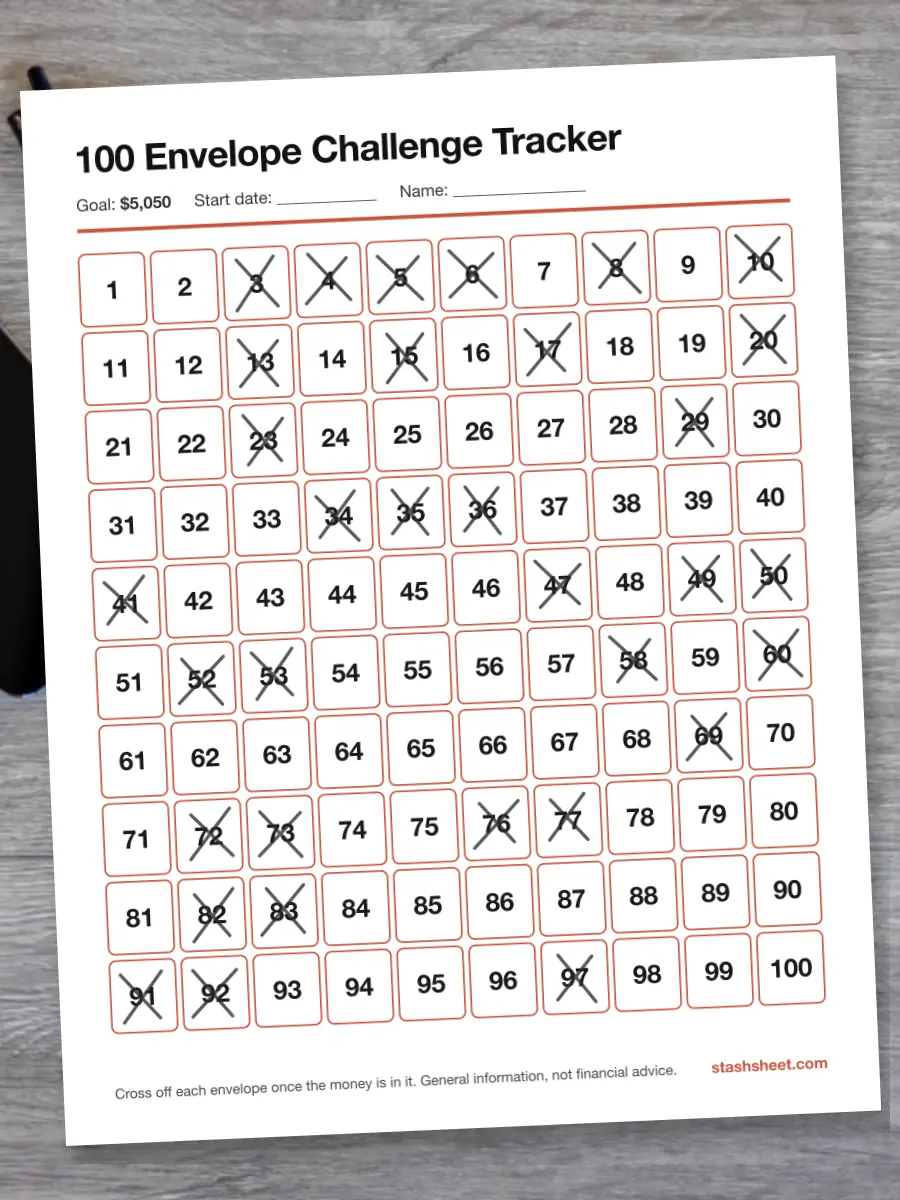
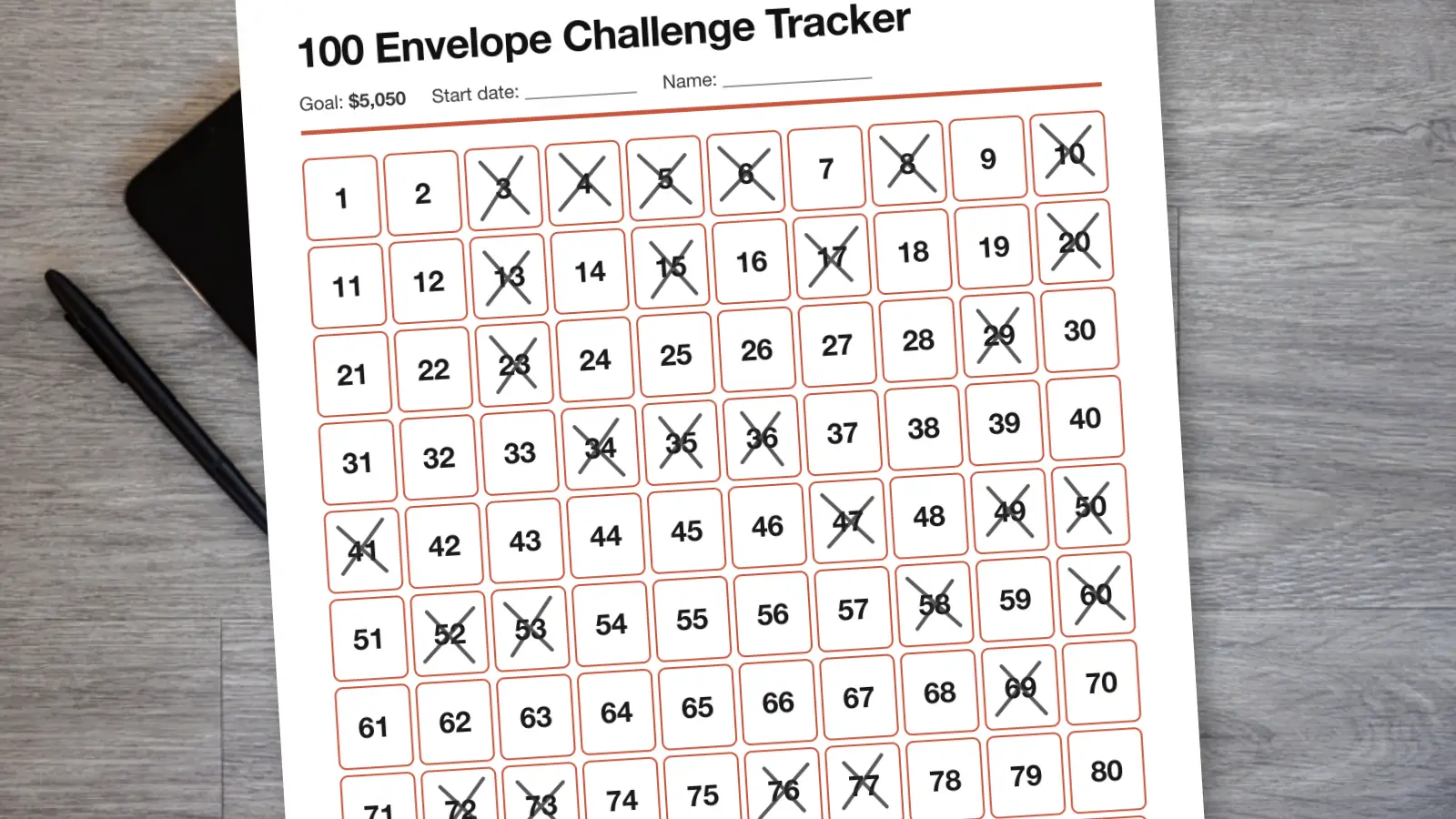
100 Envelope Challenge Tracker
Number 100 envelopes from 1 to 100. Pick one at random, put in that many dollars and cross it off here. All 100 = $5,050. Free one-page PDF, no email needed.
Download free PDF PreviewFrequently asked questions
How much money do you save with the 100 envelope challenge?
If you fill all 100 envelopes (1 to 100 dollars) you save $5,050.
How long does the 100 envelope challenge take?
The original version is 100 days, filling one envelope a day. That's about $50 a day, so most people stretch it over 6 months to a year, or fill two to three envelopes a week.
Do I have to use real envelopes?
No. Many people use the printable tracker and transfer the money to a savings account instead. Real envelopes are more fun, but cash at home is easier to lose or spend, and it isn't covered by FDIC deposit insurance.
Is there a smaller version?
Yes. Envelopes 1–50 add up to $1,275, and a 100-envelope version using quarters ($0.25 to $25) totals $1,262.50.
How much per week is the 100 envelope challenge over a year?
$5,050 divided by 52 weeks is about $97 a week, or roughly two envelopes a week. Paid every two weeks, that's about $194 per paycheck.
What if I pull a big number on a tight week?
Put it back and pull again, or set it aside for your next payday. The total stays $5,050 no matter what order you fill the envelopes in.
Sources
- CFPB: Building your savings? Start with small goals (PDF booklet)
- FDIC: Understanding deposit insurance
- FDIC: National rates and rate caps (national average savings rate)
- CFPB: Looking for an easy way to save money? Make it automatic
These are official, free resources. This article is general information, not personalized financial advice — for decisions about your own money, talk to a licensed professional or a nonprofit counselor.