General information only, not personalized financial advice. Disclaimer.
When money is tight, the advice to “save three to six months of expenses” can feel like a joke. If you’re living paycheck to paycheck, three weeks sounds hard enough.
So let’s forget that number for now. Your first goal is $500. Then $1,000. Those two milestones alone can turn a flat tire or a dentist visit from a crisis into an inconvenience.
Why a small emergency fund matters so much
Without any savings, every surprise becomes debt: a credit card, a payday loan, a late fee. Those cost even more money, which makes saving even harder. A small cushion breaks that cycle.
Step 1: Set a mini goal and make it visible
Write $500 at the top of a page — or print the $1,000 in 26 weeks tracker, which breaks the goal into small squares from $20 to $65. Stick it on the fridge. Shading squares sounds silly, but it works.
Step 2: Find the first $100 fast
Quick wins build momentum. Try a few of these this week:
- Sell 3–5 things you don’t use: kids’ outgrown clothes, gadgets, furniture. Facebook Marketplace, a local selling app or a garage sale.
- Check for forgotten money: old gift cards, unclaimed money databases (US states run free search sites; in Australia, check ASIC’s Moneysmart unclaimed money search), refunds you never chased.
- Cancel one subscription and move that amount over immediately.
- A no-spend weekend — see our no-spend challenge rules.
Step 3: Make saving automatic (even $5)
Set up an automatic transfer on payday. The amount matters less than the habit. $10 a week is $520 a year.
If your income changes week to week, try a percentage instead: 3% of whatever comes in.
Step 4: Plug the small leaks
On a low income there’s often less fat to trim, but these are worth checking:
| Leak | Typical fix |
|---|---|
| Phone plan | Switch to a cheaper prepaid or smaller carrier |
| Bank fees | Move to a no-fee account |
| Grocery waste | Meal plan and shop the pantry first (grocery tips) |
| Insurance | Shop around once a year; ask about discounts |
| Utilities | Ask about hardship or low-income programs and concession rates |
Step 5: Use “found money” on purpose
Tax refunds, bonuses, birthday money, overtime, a cheaper bill than expected — decide in advance that half (or all) goes straight to the emergency fund.
Step 6: Keep it safe but separate
Your emergency fund should be:
- Separate from your spending account, so you don’t dip into it.
- Easy to reach in a day or two when you really need it.
- Safe — not in the stock market or crypto, where it could be worth less right when you need it.
A basic savings account at a different bank from your checking works well for many people.
What counts as an emergency?
Decide this before you need it. Yes, it’s an emergency:
- Car repair you need to get to work
- Urgent medical or dental bills
- Job loss or a sudden drop in hours
- Essential appliance or home repair
Not an emergency: a sale, a holiday, concert tickets or Christmas. That’s what sinking funds are for.
If you have to use it
That’s what it’s for! Don’t feel guilty. Use it, then restart the tracker and rebuild — usually faster the second time, because the habit is already there.
Where to get free help
If you’re struggling with debt or bills, free help exists. In the US, nonprofit credit counseling agencies (look for NFCC members) offer free or low-cost advice. In Australia, the National Debt Helpline (1800 007 007) is free and confidential.
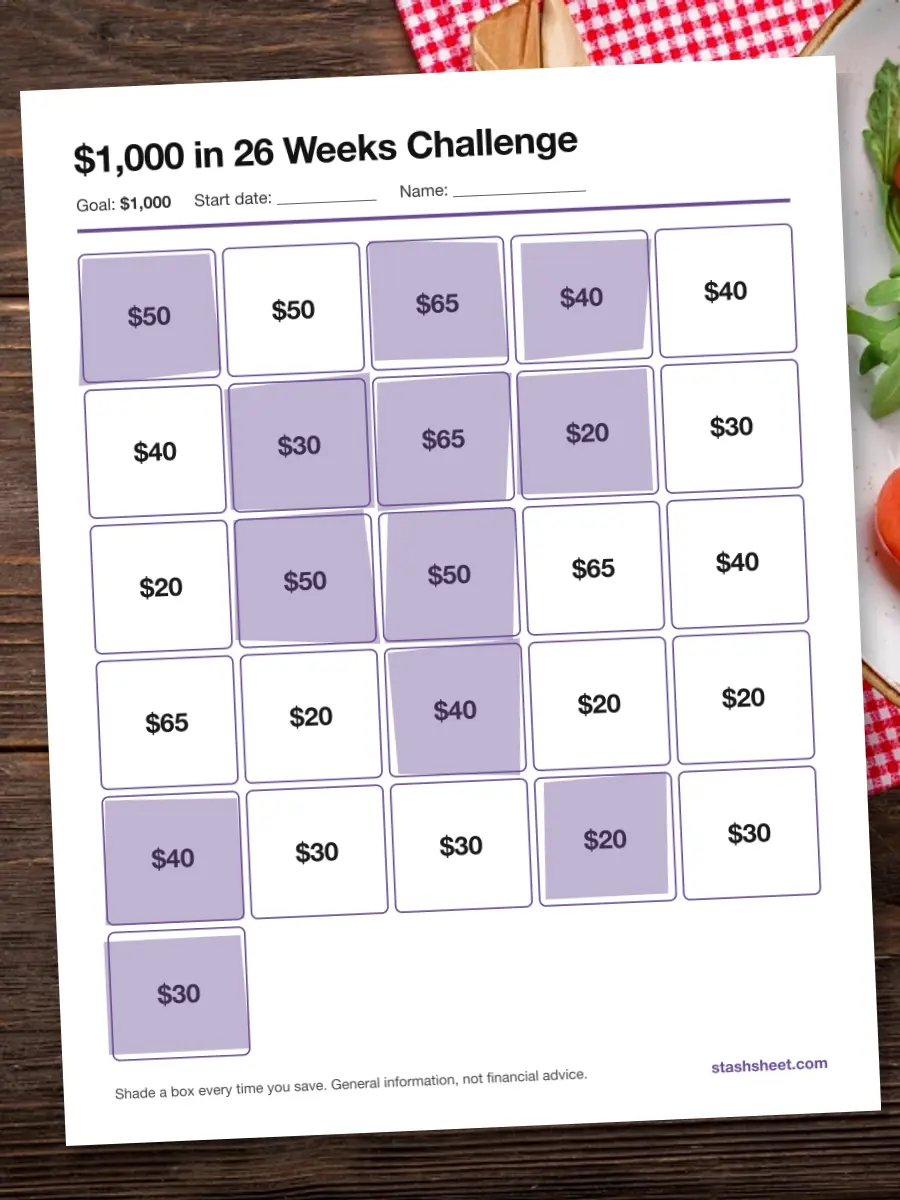
$1,000 in 26 Weeks Challenge
A gentler six-month challenge: 26 squares from $20 to $65. Perfect for an emergency-fund starter or a summer trip. Free one-page PDF, no email needed.
Download free PDF PreviewFrequently asked questions
How much should be in an emergency fund?
A common long-term goal is three to six months of essential expenses. On a low income, start with a mini goal of $500 to $1,000 — it already covers many common emergencies.
Should I build an emergency fund or pay off debt first?
Many people build a small starter fund first (around $500–$1,000) so a surprise bill doesn't go on a credit card, then focus on debt. Your situation may differ; a nonprofit credit counselor can help.
Where should I keep my emergency fund?
Somewhere safe and easy to reach in a day or two, but separate from your spending account — for example a savings account at an FDIC-insured bank or NCUA-insured credit union.
Sources
- CFPB: An essential guide to building an emergency fund
- CFPB: Building your savings? Start with small goals (PDF booklet)
- FDIC: Understanding deposit insurance
- NFCC: free resources from nonprofit credit counselors
These are official, free resources. This article is general information, not personalized financial advice — for decisions about your own money, talk to a licensed professional or a nonprofit counselor.